


What Is Gray Blending — And Is It Right for You?


Gray hair doesn’t always have to be completely covered.
For some clients, the goal isn’t:
“I never want to see a gray hair.”
It’s more like:
“Can we make the gray softer, less obvious and easier to grow out?”
That’s where gray blending comes in.
But first, we need to clear something up.
Gray blending is not one specific service.
It’s a color strategy.
The goal is to make your natural gray work with the rest of your hair so the grow-out feels softer and less noticeable than traditional solid gray coverage.
And depending on your hair, your starting color, how much gray you have and what result you want, we may achieve that in several different ways.
Gray Blending vs. Gray Coverage
These two are not the same thing.
Gray Coverage
Gray coverage is for the client who wants the gray covered as completely as possible.
That often means using permanent color at the root to match or create your desired shade.
When your natural hair grows in, you’ll see a more noticeable line between the newly grown gray and the colored hair.
For many clients, that means maintenance around:
Every 4–6 weeks.
Some clients come sooner, especially around the hairline.
If you love a rich, solid brunette, red, black or blonde base and don't mind regular maintenance, traditional gray coverage may still be your best option.
Gray Blending
Gray blending intentionally allows some variation.
Rather than trying to make every gray hair disappear, we're trying to make the contrast between your gray and your colored hair less dramatic.
The result can feel:
softer
more dimensional
more natural
and sometimes easier to maintain
But that doesn't automatically mean “maintenance free.”
We'll get to that. 😂

Option #1: Demi-Permanent Color or Gloss
For someone who wants to soften gray without creating heavy permanent coverage, a demi-permanent color or gloss can be a beautiful option.
Instead of completely erasing every gray hair, the color can give some gray strands a softer tonal effect.
Think:
Gray camouflage instead of gray elimination.
You may still see dimension.
You may still see lighter strands.
But they feel more intentional and less stark.
This can be especially nice for someone beginning to gray who isn't ready to commit to permanent root color.
Maintenance
Generally, this is something we evaluate around 4–8 weeks, depending on your percentage of gray, the shade we're using and how quickly the color fades.
The benefit is that the grow-out can be softer than permanent coverage.

Option #2: Highlights
Highlights can be one of my favorite tools for gray blending.
Why?
Because gray hair is already light.
Adding strategically placed lighter pieces can help visually connect your darker natural hair with those lighter gray strands.
Instead of:
dark hair → random bright gray
we create more:
dark + medium + light dimension
which can make the gray feel intentional.
Depending on where your gray lives, we might use:
Accent Highlights
Crown Highlights
Partial Highlights
or
Full Highlights
You don't automatically need a whole head of highlights just because you have gray.
Placement matters.

Option #3: Highlights + Root Color
This is a great middle ground for clients who want some gray coverage but don't want the hair to look like one solid color.
We can cover or soften the gray at the root while adding dimensional highlights.
That gives you:
coverage + brightness + dimension
instead of flat color.
For many of my clients, this is a really practical approach because we're not asking them to suddenly embrace every gray hair.
We're simply making their color look softer and more dimensional.
Maintenance
Root color may still need to be refreshed around 4–6 weeks.
Highlights generally don't need to be redone every time.
We can alternate appointments.
For example:
Appointment #1 — Root Retouch + Highlights
Appointment #2 — Root Retouch
Appointment #3 — Root Retouch
Appointment #4 — Root Retouch + Highlights
The exact rhythm depends on your hair.
This is where having a maintenance plan can actually save you from doing more color than you need.
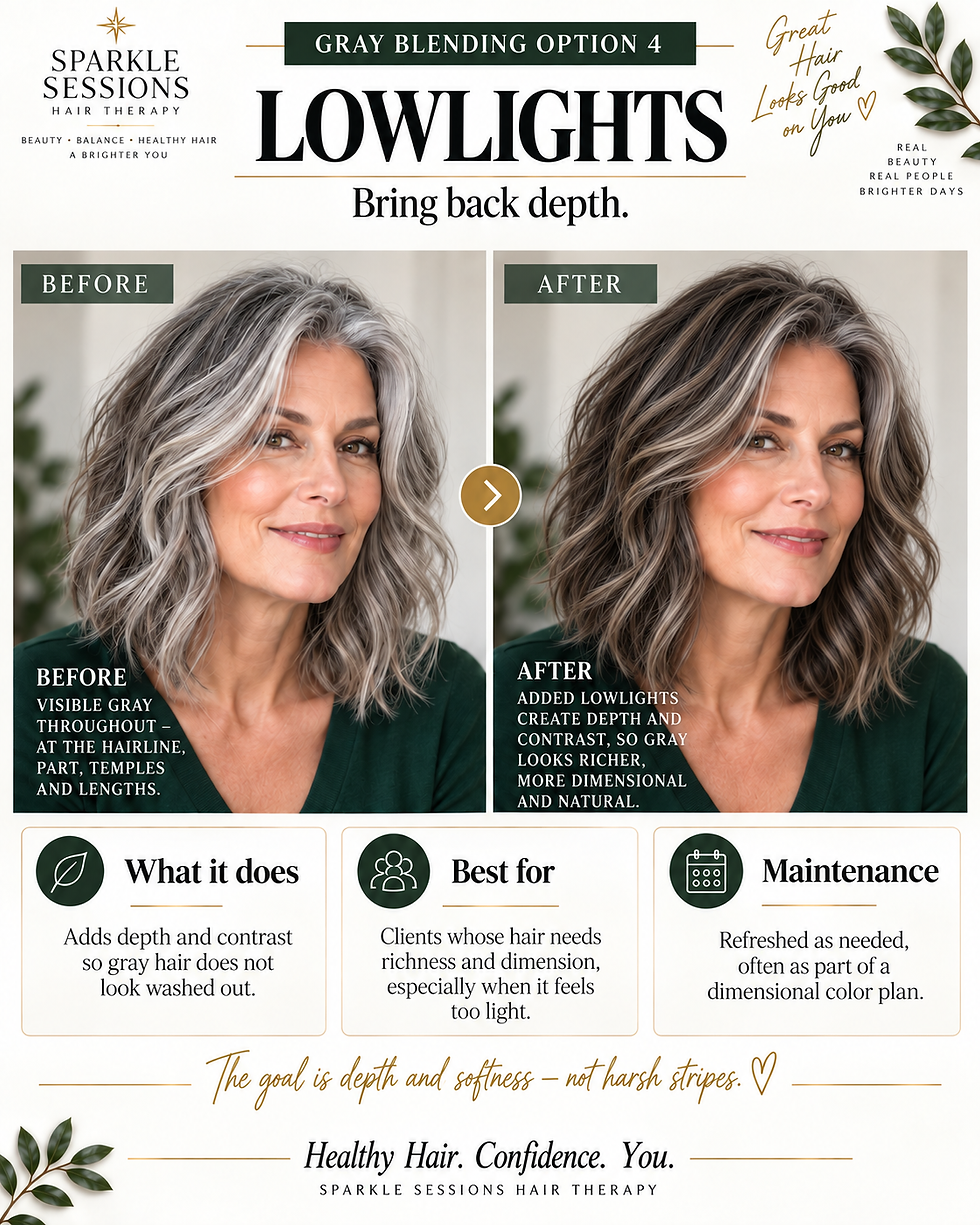
Option #4: Lowlights
Sometimes gray blending isn't about making everything lighter.
Sometimes we need darkness back.
If someone has a lot of gray or naturally light hair, strategically placed lowlights can help create depth and prevent the hair from looking washed out.
The important word here is strategic.
Too many dark pieces can suddenly turn a beautiful blended result back into obvious regrowth.
We want dimension.
Not stripes.

Option #5: Highlights + Lowlights + Toner
For certain clients, a combination gives us the most natural-looking result.
Highlights create brightness.
Lowlights create depth.
A toner or gloss helps refine the overall tone.
Together, those pieces can create a beautiful blend between:
your natural color
your gray
and your salon color.
This can be especially useful when gray isn't evenly distributed.
Because let's be real:
Gray hair rarely sends us a memo and shows up evenly everywhere. 😂
Some clients are almost completely gray at the temples and barely gray in the back.
Our color placement needs to reflect that.
What About Going Completely Gray?
This is where I want to be really clear about what I offer at Sparkle Sessions.
You've probably seen dramatic transformations online where someone has years of dark permanent color and, in one giant appointment, the stylist:
bleaches out the old color,
lightens the entire head,
then goes back in with highlights,
lowlights,
toners,
and sometimes several formulas to recreate a silver-and-gray pattern.
Those are gray transformations.
They're beautiful when they work.
They're also very time consuming, very expensive and extremely demanding on the hair.
And they're not a service I choose to offer.
At Sparkle Sessions, I'm much more interested in creating a practical transition plan that works with your hair over time.
I would rather protect the integrity of your hair and gradually move toward a softer result than spend an entire day aggressively removing years of artificial color trying to manufacture gray hair.
Because here's another piece people don't always talk about:
That beautiful transformation photo is Day One.
The hair still grows.
Toners fade.
Artificial silver and gray tones change.
Previously colored hair behaves differently from natural gray.
And that dramatic transformation still requires maintenance.
For me, the time, chemical stress and longevity of those services don't make them the best fit for the type of Hair Therapy I want to provide.
So How Do We Transition Without a Gray Transformation?
Slowly.
Strategically.
And with realistic expectations.
Depending on your starting point, we might:
Allow more natural gray to grow between appointments.
Switch from permanent color to a softer demi-permanent formula.
Gradually lighten selected pieces with highlights.
Add lowlights only where they're needed.
Use glosses or toners to refine the overall tone.
Adjust your haircut as the old color grows out.
And sometimes the answer is simply:
Let it grow.
There is nothing wrong with allowing your natural gray to come in and cutting away the previously colored hair over time.
It isn't dramatic.
It won't make a viral six-hour transformation video.
But it can be a much healthier and more realistic transition.
How Often Does Gray Blending Need Maintenance?
This is probably one of the biggest misconceptions.
People hear gray blending and think:
“Great! I'll come twice a year.”
Maybe.
But probably not. 😂
It depends on the technique.
A rough guide might look like:
Permanent Root Coverage:approximately every 4–6 weeks
Demi-Permanent Gray Blending:approximately every 4–8 weeks
Gloss/Toner Refresh:approximately every 6–8 weeks, depending on fading
Highlights:approximately every 8–16 weeks, depending on placement and desired brightness
Lowlights:as needed to maintain dimension
And here's where we can get smart with your schedule.
You don't have to do everything at every appointment.
We can rotate services.
That often means healthier hair, less time in the salon and less money spent unnecessarily.
Will Gray Blending Cover All My Gray?
Usually, that's not the goal.
If your expectation is:
“I want 100% of my gray completely gone.”
Then you probably want gray coverage, not gray blending.
If your expectation is:
“I don't mind seeing some gray. I just want it to look softer and more intentional.”
Now we're talking gray blending.
That distinction is really important.
Neither choice is better.
They're simply different goals.
Does Gray Blending Work on Dark Hair?
Absolutely — but expectations matter.
The greater the contrast between your natural hair and the gray, the more noticeable that gray will naturally be.
Someone with very dark brown or black hair and bright white gray has a lot of contrast.
We can add dimension to soften that contrast.
But we're not going to magically make dark hair and white hair become the same color without coloring one of them.
That's where your consultation matters.
What About Resistant Gray?
Another little surprise:
Not all gray hair behaves the same way.
Some gray grabs color easily.
Some is incredibly resistant.
Some feels coarse.
Some is silky.
Some takes toner beautifully.
Some looks like it politely declined the invitation. 😂
That's why two people who both say:
“I'm about 50% gray.”
may need completely different formulas and services.
Is Gray Blending Right for You?
You might love gray blending if:
You're comfortable seeing some natural gray.
You're tired of a harsh root line.
You want softer, dimensional color.
You're beginning to transition toward your natural gray.
You want to stretch the appearance of your grow-out.
You like highlights and dimensional color.
You understand that “blended” doesn't mean “maintenance free.”
Traditional gray coverage may make more sense if:
Seeing gray really bothers you.
You want a solid, consistent base color.
You prefer darker or richer color from roots through ends.
You're happy coming in every 4–6 weeks.
Your priority is maximum coverage rather than a soft transition.
And if you're not sure?
That's exactly what consultations are for.
Bring Me Pictures — But Bring the Right Pictures
Inspiration photos are extremely helpful.
But instead of only showing me the beautiful finished result, tell me:
What part do you like?
The brighter front?
The darker underneath?
The silver?
The dimensional brunette?
The softer root?
And tell me what you don't want.
That may be even more helpful.
We can build your plan from there.
Sparkle's Hair Therapy Tip 💚
Before deciding whether to blend or cover your gray, ask yourself one question:
“How much gray am I actually comfortable seeing?”
Not:
“What does Pinterest say is trending?”
Not:
“What did my friend do?”
Not:
“Am I supposed to embrace my gray because I'm a certain age?”
😂
Your hair. Your choice.
If you want every gray hair covered, we'll talk about coverage.
If you're ready to see some gray but want it to feel softer and more intentional, let's talk about blending.
And if your long-term goal is to grow your natural gray completely out, we can create a realistic transition plan without putting your hair through an all-day gray transformation.
The best color plan isn't the one that looks great for one photo.
It's the one that still makes sense six weeks, six months and a year from now.
Sparkle Sessions Hair TherapyHealthy Hair. Confidence. You. 💚


Comments